Showing posts with label Poet. Show all posts

Tuesday, 23 August 2011

112th Birthday of Jorge Luis Borges Today

Jorge Luis Borges

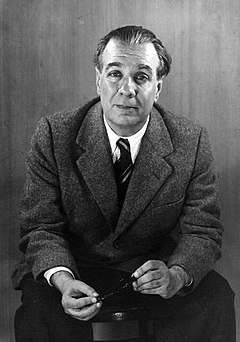
Borges in 1951, by Grete Stern
BornJorge Francisco Isidoro Luis Borges Acevedo
24 August 1899
Buenos Aires, Argentina
Died14 June 1986 (aged 86)
Geneva, Switzerland
OccupationWriter, poet, critic, librarian
LanguageSpanish


Jorge Francisco Isidoro Luis Borges Acevedo (August 24, 1899 – June 14, 1986), known as Jorge Luis Borges (Spanish pronunciation: [ˈxorxe ˈlwis ˈβorxes]), was an Argentine writer, essayist, poet and translator born in Buenos Aires. In 1914 his family moved to Switzerland where he attended school and traveled to Spain. On his return to Argentina in 1921, Borges began publishing his poems and essays in surrealist literary journals. He also worked as a librarian and public lecturer. In 1955 he was appointed director of the National Public Library (Biblioteca Nacional) and professor of Literature at theUniversity of Buenos Aires. In 1961 he came to international attention when he received the first International Publishers' Prize, the Prix Formentor. In 1971 he won the Jerusalem Prize. His work was translated and published widely in the United States and in Europe. Borges himself was fluent in several languages. He died in Geneva, Switzerland, in 1986.
His work embraces the "character of unreality in all literature".[2] His most famous books, Ficciones (1944) and The Aleph (1949), are compilations of short stories interconnected by common themes such as dreams, labyrinths, libraries, animals, fictional writers, religion and God. His works have contributed to the genre of science fiction as well as the genre of magic realism, a genre that reacted against the realism/naturalism of the nineteenth century.[3][4][5] In fact, critic Angel Flores, the first to use the term, set the beginning of this movement with Borges's Historia universal de la infamia (A Universal History of Infamy) (1935).[6] Scholars also have suggested that Borges's progressive blindness helped him to create innovative literary symbols through imagination.[7] His late poems dialogue with such cultural figures as Spinoza, Camões, and Virgil.
His international fame was consolidated in the 1960s, aided by the "Latin American Boom" and the success of Gabriel García Márquez's Cien Años de Soledad (One Hundred Years of Solitude).[3] Writer and essayist J. M. Coetzee said of him: "He, more than anyone, renovated the language of fiction and thus opened the way to a remarkable generation of Spanish American novelists.
jorge luis borges - A Writer, Poet, Critic, Librarian "jorge luis borges" Rare Photos Collection | jorge luis borges Biodata | jorge luis borges Poem

BORGES
Borges in 1951, by Grete Stern
BornJorge Francisco Isidoro Luis Borges Acevedo
24 August 1899
Buenos Aires, Argentina
Died14 June 1986 (aged 86)
Geneva, Switzerland
OccupationWriter, poet, critic, librarian
LanguageSpanish


Jorge Luis Borges: Selected Stories & Other Writings

Borges in 1951, by Grete Stern

POEMS OF THE NIGHT BY JORGE LUIS BORGES


JORGE LUIS BORGES: A 25 AÑOS DE SU MUERTE.

112th birthday of Jorge Luis Borges


Jorge Luis Borges, 1899 - 1986

Jorge L Borges

The Art of Poetry by Jorge Luis Borges

To gaze at a river made of time and water
and remember Time is another river.
To know we stray like a river
and our faces vanish like water.

To feel that waking is another dream
that dreams of not dreaming and that the death
we fear in our bones is the death
that every night we call a dream.

To see in every day and year a symbol
of all the days of man and his years,
and convert the outrage of the years
into a music, a sound, and a symbol.

To see in death a dream, in the sunset
a golden sadnesssuch is poetry,
humble and immortal, poetry,
returning, like dawn and the sunset.

Sometimes at evening there's a face
that sees us from the deeps of a mirror.
Art must be that sort of mirror,
disclosing to each of us his face.

They say Ulysses, wearied of wonders,
wept with love on seeing Ithaca,
humble and green. Art is that Ithaca,
a green eternity, not wonders.

Art is endless like a river flowing,
passing, yet remaining, a mirror to the same
inconstant Heraclitus, who is the same
and yet another, like the river flowing.

[Jorge+Luis+Borges]
Jorge Luis Borges picture

Jorge_Luis_Borges

Friday, 27 May 2011

Very Beautiful Poet Gil Scott-Heron Photos | Gil Scott-Heron Collection | Gil Scott-Heron Pics | Gil Scott-Heron Information

genius, activist, brilliant poet, jazz-funk pioneer, rap pioneer, possessed of a beautiful spoken and singing voice, possessed of both a searing intelligence and a sense of humour. The guy's had his troubles with drugs in recent years, and we can only hope he gets it together and keeps going, because the world needs more people like him. And in combination with Brian Jackson he's just unbeatable. Gil for President! Brian for VP (with his hair in a bun)!

Some unreleased live recordings sound like they've been recorded from the venue's bathroom, then there are the quality ones like this one. This fantastic, powerhouse two hour performance was recorded straight from mixing desk at the Bottom Line club into a PCM, an early digital recorder, then transferred to WAV and then FLAC. It sounds great, and is now my favourite live Gil Scott-Heron album. It just needed a cover, so I made one.

Gil Scott Heron Rare Photo | Gil Scott Heron Pics | Gil Scott Heron Bio | Gil Scott Heron Info

Gil Scott Heron

Gil Scott-Heron is an American poet, musician, and author known primarily for his late 1960s and early 1970s work as a spoken word performer. He is associated with African American militant activism, and is best known for his poem and song "The Revolution Will Not Be Televised".

Born in Chicago in 1949, Scott-Heron had a difficult, itinerant childhood. After his parents divorced he was sent to live with his grandmother in Lincoln, Tennessee. A civil rights campaigner, she introduced him to both music and literature. But the young Scott-Heron endured constant racial abuse as one of only three black children picked to integrate an elementary school in nearby Jackson. Returning to New York to live with his mother, he got a different perspective on oppression in the housing projects of the Bronx.

But he was too bright to settle for less. After publishing an acclaimed novel, The Vulture, at the age of 19, he won a place at Lincoln University, Pennsylvania, the alma mater of his hero, black poet Langston Hughes. He dropped out after a year to pursue a career in poetry. In 1970 producer Bob Thiele convinced him to set his first collection, Small Talk at 125th and Lenox, to music; the album's conversational style and funky percussion earned Scott-Heron the tag of "the godfather of rap". He once joked, with typical insouciance: "I ain't saying I didn't invent rapping. I just cannot recall the circumstances."

Classic protest songs such as The Revolution Will Not Be Televised and Whitey On the Moon were fuelled by a keen, angry intelligence. His back catalogue also boasts several articulate dissections of an addict's mindset, including The Bottle and Angel Dust. On 1971's Home Is Where the Hatred Is, he sang, "You keep saying kick it, quit it, kick it, quit it, God but did you ever try to turn your sick soul inside out so that the world can watch you die?" It has never been clearly established when Scott-Heron became addicted to cocaine; looking back on his works about drugs, it seems the line between empathy and autobiography was blurred throughout his career. Even in recent years, he has used his ready wit to fudge the issue of his drug use.

in my opinion, Gil Scott Heron is THE MOST important political musician of the last 40 years.
he made it happen.
he invented it.
respect!
SMALL TALK AT 125th STREET & LENNOX (1970)